Kikudana – I made a podcast player for Audiobookshelf

Audiobookshelf is a selfhosted opensource server that hosts both all your podcasts and all your ebooks if you want.

Since I am listening to podcasts daily I wanted to use Audiobookshelf to be able to track listening progress across devices.

Now I am subscribed to 70+ podcasts with some of them having an archive of 10+ years. Tens of thousands of episodes.

This posed a seemingly huge problem to the already available Audiobookshelf-compatible podcast clients which prompted me to write my own podcast player.

I present: Kikudana
Kikudana combines the Japanese kiku — “to listen” – with tana, “shelf”. The name loosely means “a shelf for listening”, a small nod to both podcasts and Audiobookshelf.

As said there are many podcast player apps already and I thought of features that I did not find in others.

For a start: Kikudana can handle very very large podcast libraries. Talking about tens-of-thousands of podcast episodes in hundreds of podcasts. It won’t crash, it will sync, it will present and it will work. It will respect your listening queue and not interfere by deleting it. If you tap another episode it will ask you and sort your queue, never missing a beat.

There is lots of more features:

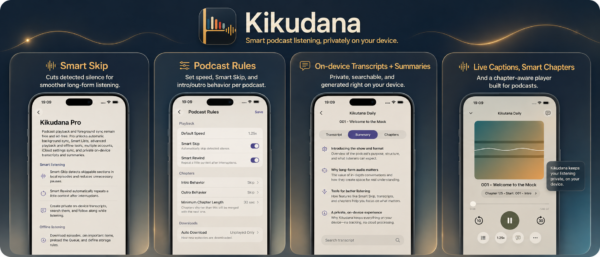
  • Smart Skip – removes detected silence from downloaded episodes while keeping chapters, seeking and listening progress perfectly aligned to the original timeline.
  • Smart Rewind – automatically rewinds after interruptions, so you naturally pick up where you left off.
  • Podcast Rules – define playback speed, Smart Skip behavior, intro/outro skipping, transcription and summary settings individually for each podcast.
  • Private on-device Transcripts – create searchable, timestamped transcripts locally with Apple’s on-device speech technology, including tap-to-seek and live word following.
  • Private AI Summaries – generate chapter summaries, key points and even fallback chapter titles locally on-device with Apple Intelligence.
  • Live Captions for Podcasts – display synchronized transcript captions directly on the Player cover as continuous text or compact pages.
  • Smart Chapters – Kikudana can derive chapters from timestamps in shownotes or create useful time-based sections when a podcast provides no chapters.
  • Powerful Smart Lists – build persistent podcast collections with their own episode views, sorting and filtering, bulk Queue actions and distinctive cover decks.
  • Native CarPlay experience – Podcasts, Queue, chapters, playback speed, downloads, Smart Lists and Smart Skip use the same Player and listening state as the iPhone/iPad app.

I tried to polish it as much as possible within the last month and hope you like it.

It’s a free app for the base functionality with a pro-upgrade either perpetual or subscription. It will receive constant updates as all my apps do for years to come.

I hope you will like it!
AppStore: https://apps.apple.com/us/app/kikudana/id6785291445
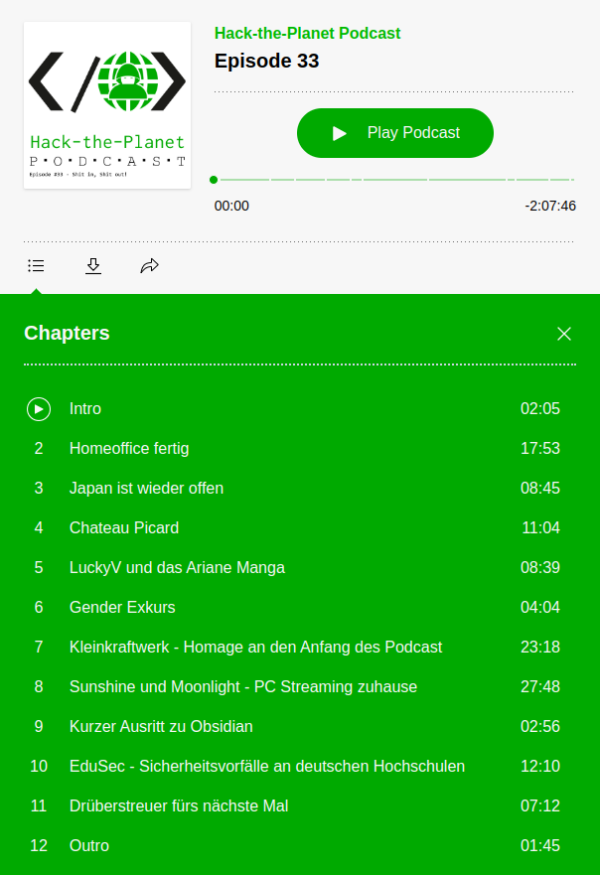
Hack-the-Planet Podcast Episode 33: Shit in, Shit out!

Nach über einem Jahr haben wir uns wieder zusammengefunden und aufgezeichnet. Aber hört selbst:

Links:

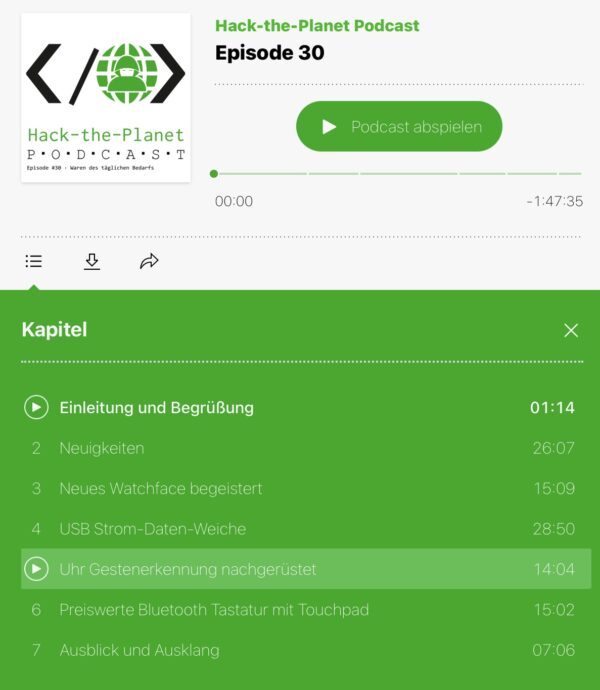
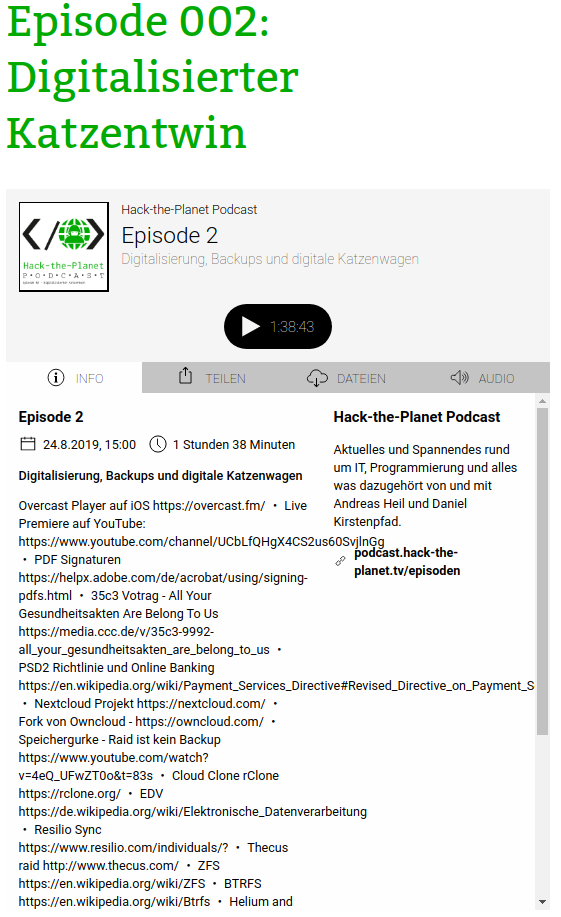
Hack-the-Planet Podcast Episode 30: Waren des täglichen Bedarfs

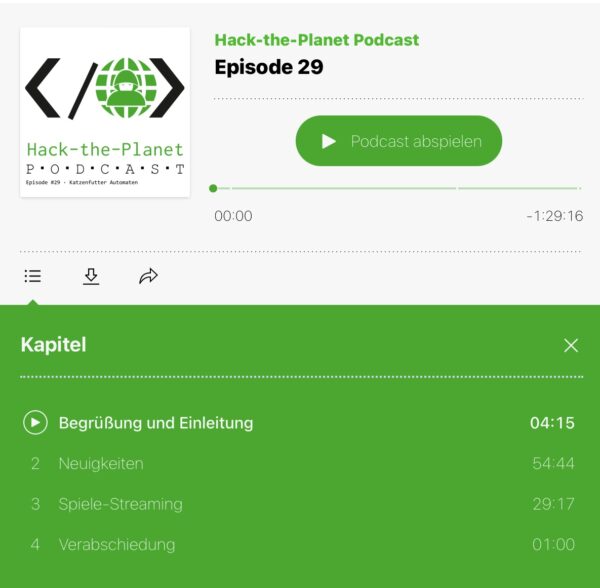
Hack-the-Planet Podcast Episode 29: Katzenfutter Automaten

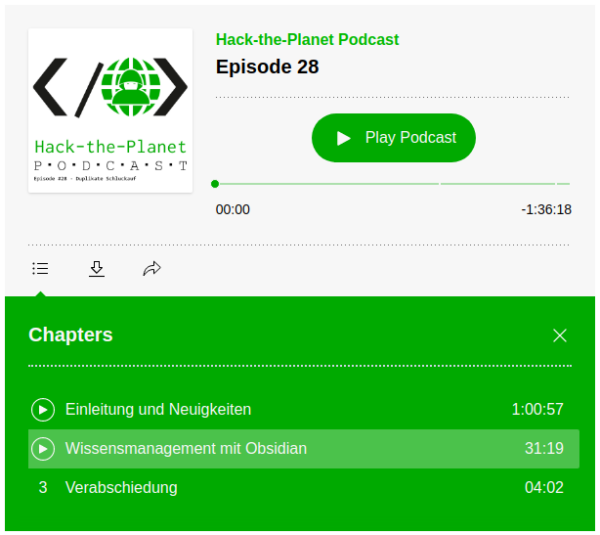
Hack-the-Planet Podcast Episode 28: Duplikate Schluckauf

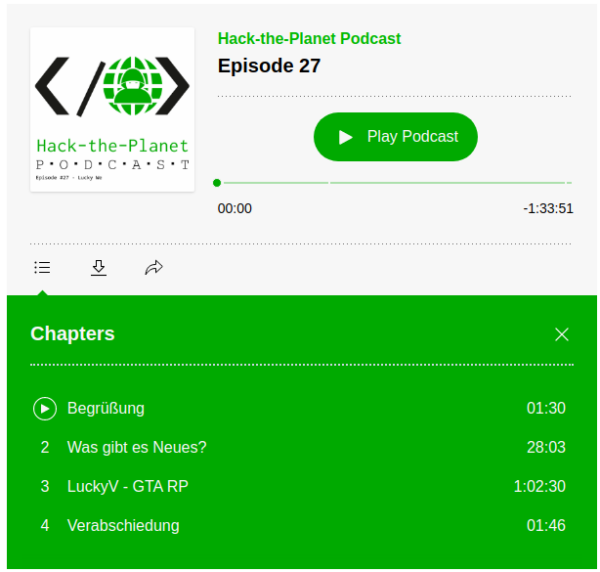
Hack-the-Planet Podcast: Episode 27 – Lucky We

Lucky We

Hack-the-Planet Podcast: Episode 26

Gestern. Heute. Morgen. Teil 1

Nach kurzer kreativer Pause werfen Daniel und Andreas einen Blick darauf, was sich im Bereich der Digitalisierung den alles so getan hat.

Hack-the-Planet Podcast: Episode 25

Diesmal gehen wir der Frage nach, wie viel Speicherplatz ein 5 Meter PNG File benötigt, das Daniel für seinen DIY Arcarde Automaten gebaut hat, wundern uns über LED-Leuchten an, die wie echter Himmel aussehen sollen und freuen uns über den “Digitalen Alltag als Experiment”.

Links

ASIO4All – http://www.asio4all.org/
Corne Keyboard – https://github.com/foostan/crkbd
Prusa Mini – https://www.prusa3d.com/original-prusa-mini/
Andreas YouTube Kanal: https://www.youtube.com/c/AndreasHeil/featured
Forschungsgemeinschaft elektronische Medien e.V. TU-Ilmenau: http://streaming.fem.tu-ilmenau.de/
Overpass Turbo – https://overpass-turbo.eu/
Overpass API – https://wiki.openstreetmap.org/wiki/Overpass_API
Openstreetmap – https://www.openstreetmap.org
Resilio Sync – https://www.resilio.com/individuals/
Buch Alltag als Experiment – https://www.transcript-verlag.de/978-3-8376-4886-7/digitaler-alltag-als-experiment/
Bürowabe von Panasonic – https://www.golem.de/news/japan-panasonic-bringt-buerowabe-fuers-homeoffice-2008-150435.html
Selbstgebautes Ambilight – https://www.schrankmonster.de/2014/01/12/setting-boblight-raspberry-pi-raspbmc/
Misola LED Tageslichtpanel – https://www.mitsubishielectric.co.jp/news/2020/0204-b.html
Mandalorian Making Of – https://www.indiewire.com/2020/04/mandalorian-documentary-disney-plus-1202225196/
Farbwiedergabeindex CRI – https://de.wikipedia.org/wiki/Farbwiedergabeindex
Retrogames e.V. – https://www.retrogames.info/
Retropie – https://retropie.org.uk/
Bubble Bobble Bartop Arcade built – https://www.schrankmonster.de/2020/08/22/a-self-built-bubble-bobble-bartop-arcade-machine/
LEGO Star Wars 75253 BOOST Droide – https://www.lego.com/en-de/product/droid-commander-75253
Ikea Bygglek – https://zusammengebaut.com/lego-ikea-bygglek-interview-bilder-infos-100595/
Arpanet auf ESP32 – https://de.wikipedia.org/wiki/Arpanet
PH_0x17 baut Arpanet auf ESP32 – https://twitter.com/PH_0x17

Hack-the-Planet Podcast: Episode 24

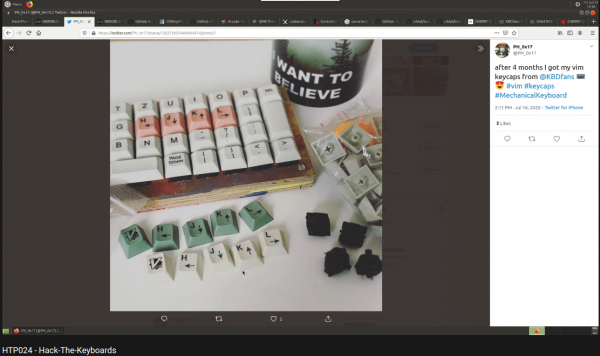
Wir haben uns wieder zusammengefunden – diesmal mit unserem Gast Philipp von nerdbude.com – und haben über Tastaturen, Github Arctic Vault, OCRmyPDF und einen selbstgebauten Arcade Automat gesprochen.

Wie schon bei der letzten Folge 23 haben wir zusätzlich zur Tonspure eine Videospur aufgezeichnet – allerdings nicht als “Talking-Heads” Episode sondern während wir über die Themen sprechen versuchen wir die Themen mit zusätzlichem Inhalt zu unterfüttern – Links und Bilder eben.

Link zu YouTube

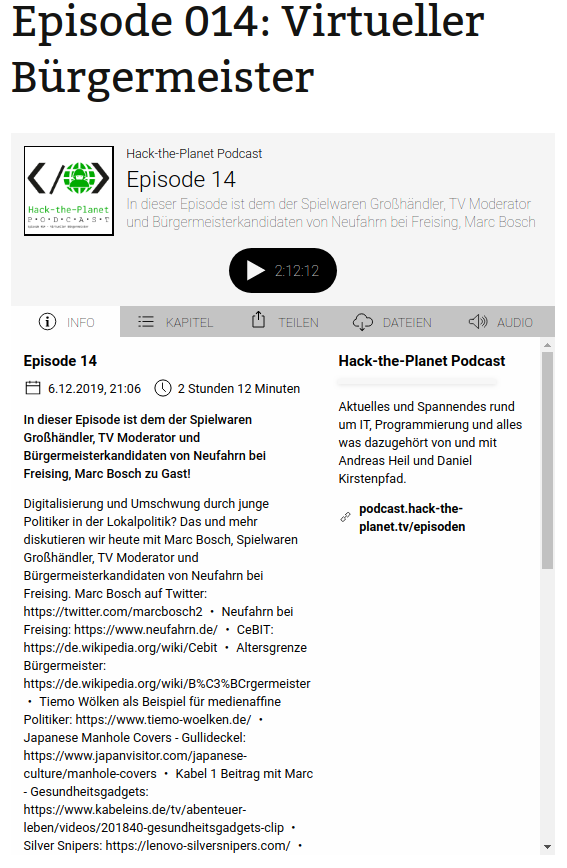
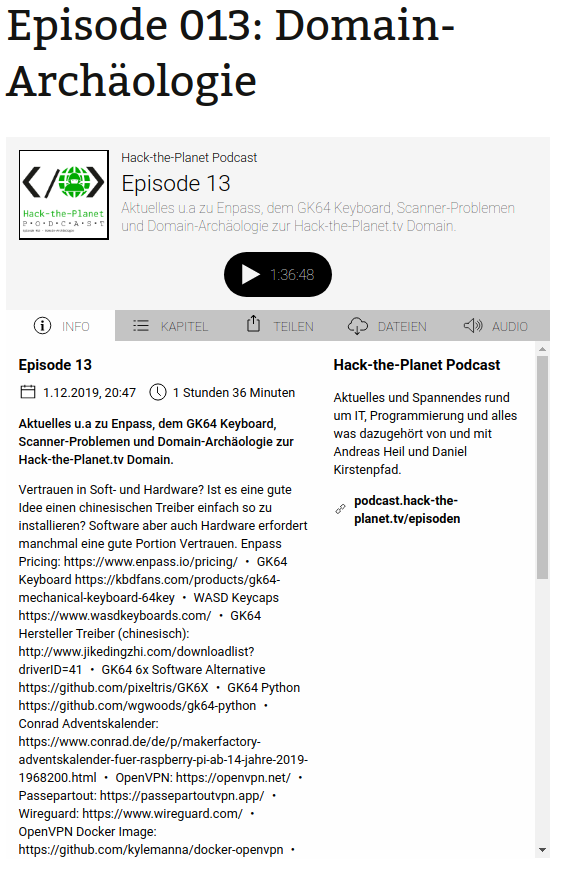
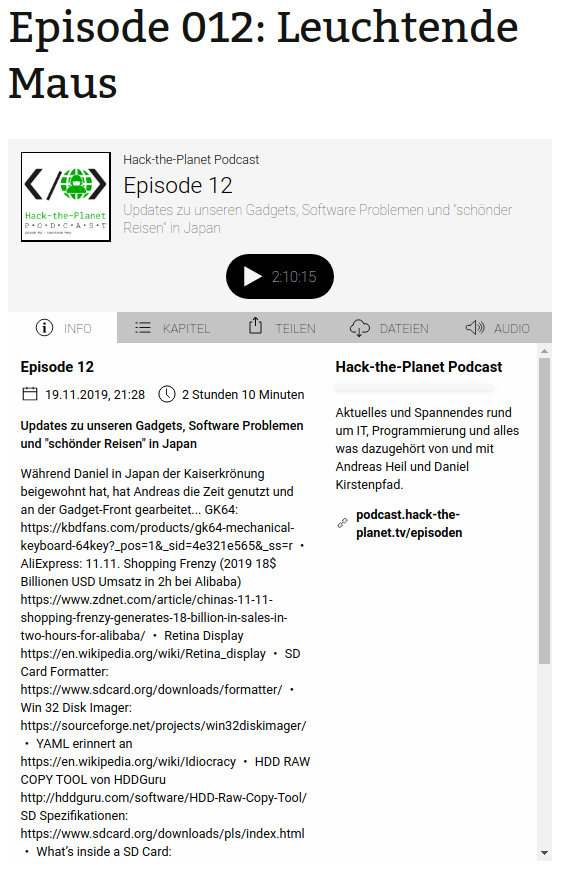
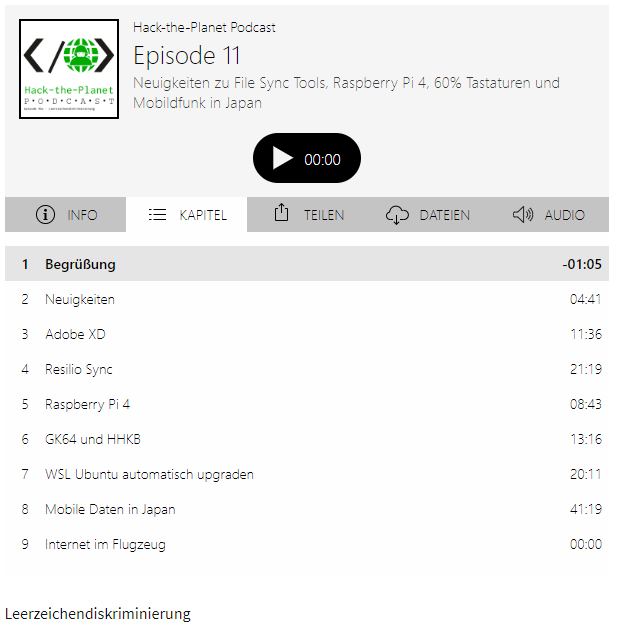
Hack-The-Planet Podcast: Episode 17

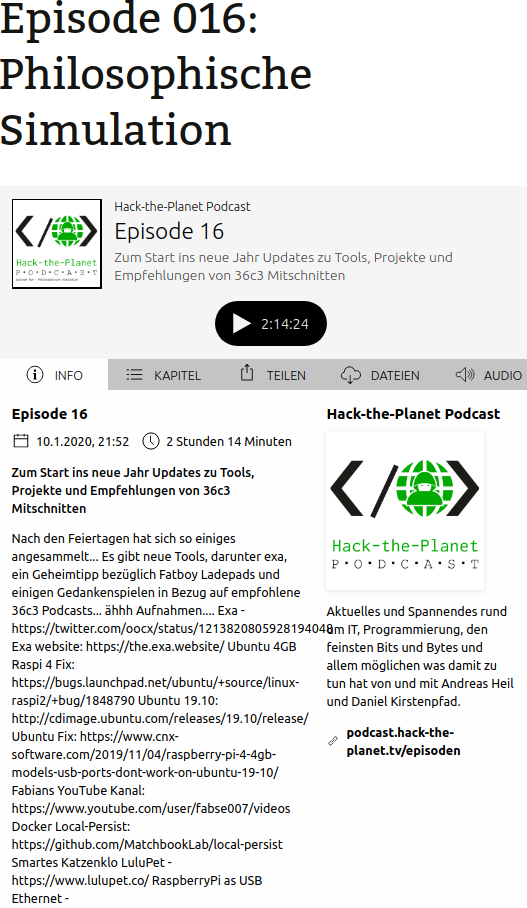
Hack-The-Planet Podcast: Episode 16

Links:

Hack-The-Planet Podcast: Episode 10

Shownotes

Hack-The-Planet Podcast: Episode 009

Hack-the-Planet Podcast: Episode 006

Episode 006: “Monitoring Release Pipeline” ist fertig und steht bald zum Download und zeit-sourveränem anhören bereit.

Auf der Homepage, im Feed und auf YouTube:

Diesmal unterhält Andreas sich mit mir über:

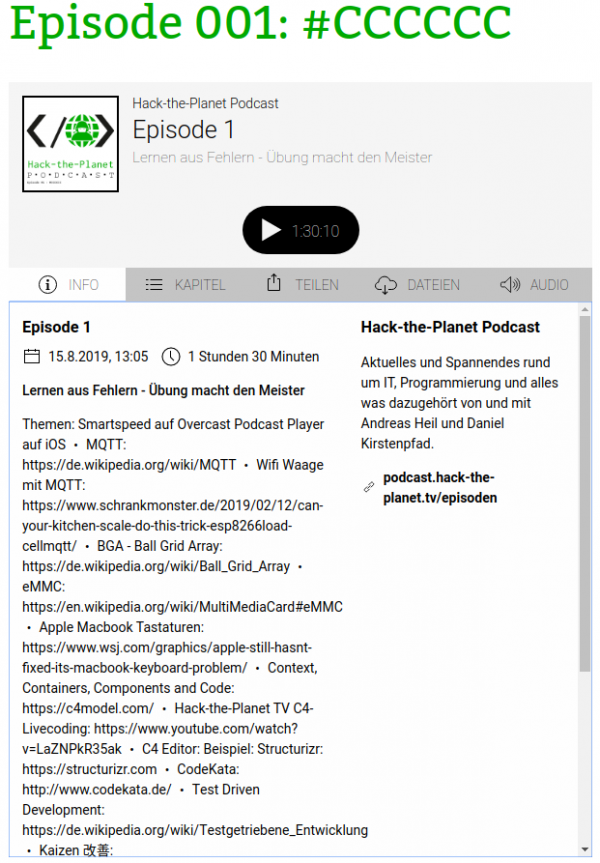
Hack-The-Planet Podcast: Episode 003

Wir haben wieder etwas aufgenommen. Der Release heute ab 15 Uhr wie gewohnt hier und hier sogar mit Live-Chat.

Diesmal geht es um:

  1. Scanner Pro auf iOS – https://apps.apple.com/us/app/scanner-pro/id333710667 
  2. Scanbot auf iOS – https://scanbot.io/en/index.html 
  3. Abo-Modelle bei Software und Diensten
  4. RING Kamera und Überwachungssystem – https://de-de.ring.com/
  5. Canary Indoor Camera – https://canary.is/
  6. Surveillance Station – https://www.synology.com/en-global/surveillance
  7. Ring has more than 400 police “partnerships” – https://arstechnica.com/tech-policy/2019/08/ring-has-more-than-400-police-partnerships-company-finally-says/
  8. Jumbo Privacy – https://blog.jumboprivacy.com/ – App Store: https://apps.apple.com/us/app/jumbo-privacy/id1454039975?ls=1
  9. Tim Berners-Lee Projekt “Solid”: https://solid.mit.edu/https://en.wikipedia.org/wiki/Solid_(web_decentralization_project)https://solid.inrupt.com/how-it-works 
  10. Ubuntu – https://ubuntu.com/
  11. Throw-Away Remote VNC Linux Desktop in a Docker container – https://www.schrankmonster.de/2019/08/27/a-throw-away-linux-desktop-in-a-container/ 
  12. Virtual Network Computing – https://en.wikipedia.org/wiki/Virtual_Network_Computing
  13. Stephen Wolfram – https://blog.stephenwolfram.com/
  14. Speed of Light in Medium – https://en.wikipedia.org/wiki/Speed_of_light

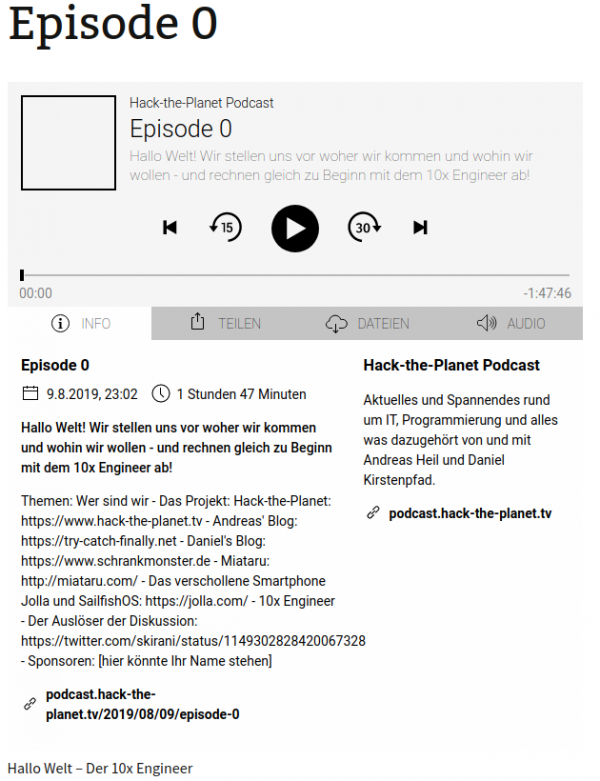
Hack-The-Planet Podcast: Episode 0

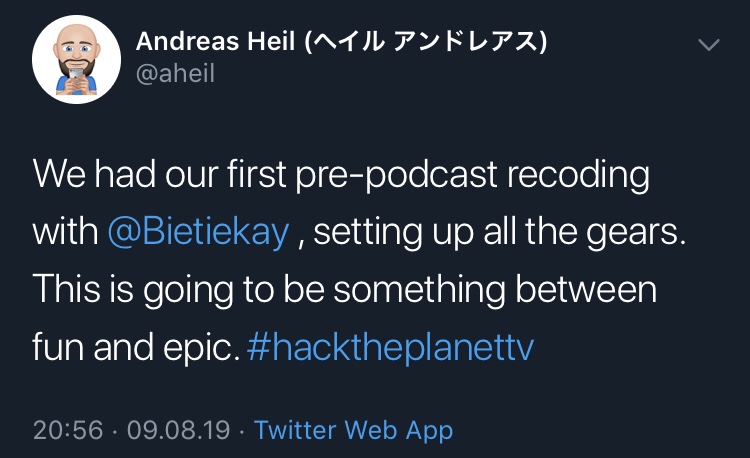
A friend of mine started something and I have the honor to be part of it. The world now has one additional podcast to listen to. It’s in german though. For now at least.

We are still working on the website, the feed and the audio mixing and recording quality. So bear with us.

And now: Episode 0 is upon us!

Es ist egal, aber

Tocotronic is one of the bands I listened to during my teens/twenties. That dates me, that dates the band.

It’s very german. You’ll find their music on most streaming platforms. I recommend starting with the albums “wir kommen um uns zu beschweren” and “es ist egal aber”.

Anyhow. Now one member of the band starts a podcast!

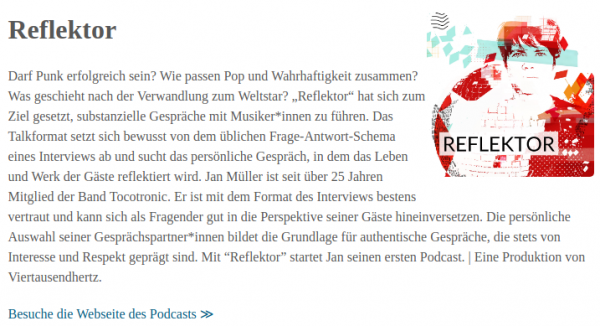
Jan Müller ist seit über 25 Jahren Mitglied der Band Tocotronic. Er ist mit dem Format des Interviews bestens vertraut und kann sich als Fragender gut in die Perspektive seiner Gäste hineinversetzen. Die persönliche Auswahl seiner Gesprächspartner*innen bildet die Grundlage für authentische Gespräche, die stets von Interesse und Respekt geprägt sind. Mit “Reflektor” startet Jan seinen ersten Podcast. 

https://viertausendhertz.de/reflektor

the future of (speech) podcasts

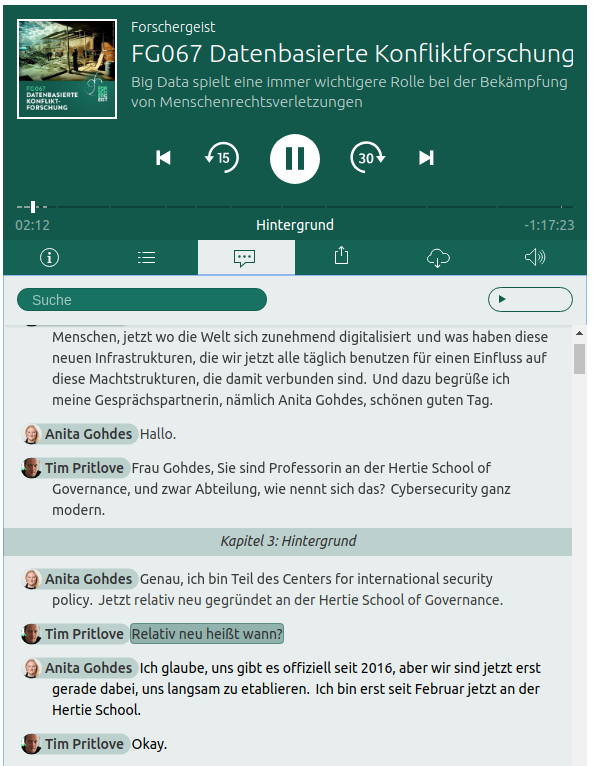
The Podlove project once again leads the way to improve the experience and the way we interact with knowledge and thoughts. With the most current announcement and introduction of transcription-support for podcasts. Click on it right now and try it yourself.

Fulltext-search. Listening to podcasts by reading them. This-is-amazing!

Transcripts are coming

Transcripts are an incredibly desirable thing to have for podcasts: they allow searching for specific parts, increase searchability by search sites when presented properly and they increase the accessibility of audio content significantly too.

However, transcripts have been considerably difficult to be created and used. Manually created transcripts are costly in terms of time and money and even if you spend the money there has been a lack of technical standards for storing and integrating transcripts into websites in a defined way.

This is now slowly changing: more and more automated speech-to-text systems are becoming available at reasonable costs and they are creating ever better transcripts with more and more languages being supported.
Still, automatic transcripts trail manually created transcripts in terms of accuracy, punctuation and so on but they are increasingly useful when they are primarily used for improving search results or helping you with your internal research when trying to find content in your older episodes.

New services are also coming up to deal with these problems by allowing users to quickly build on automatic transcripts and improve them manually in an assisted fashion. We will soon see a landscape of tools and services that will make creating transcripts easy and cheap enough for more and more podcasters so it’s time to come up with a good integration.

Last but not least, the WebVTT file format has become a de-facto common denominator for passing transcripts along, supporting time codes, speaker identification and a rudimentary set of meta data. While not perfect it’s enough to get a transcript infrastructure up and running and Podlove is leading the way.

from the Podlove Publisher 2.8 announcement